
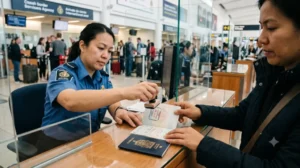
قوانین و مراحل مهر پاسپورت کانادا در فرودگاهها: راهنمای حقوقی
بررسی رویههای مهر زدن پاسپورت در فرودگاههای بینالمللی کانادا، موضوعی حیاتی برای گردشگران و اتباع خارجی است تا فرآیندهای مهاجرتی را بهراحتی و بدون دردسر طی کنند.
اسم دسته بندی
زمان مطالعه
۲ دقیقه
Lorem ipsum dolor sit amet, consectetuer adipiscing elit. Aenean commodo ligula eget dolor. Aenean massa. Cum sociis natoque penatibus et magnis dis parturient montes, nascetur ridiculus mus. Donec quam felis, ultricies nec, pellentesque eu, pretium quis, sem. Nulla consequat massa quis enim. Donec pede justo, fringilla vel, aliquet nec, vulputate
Lorem ipsum dolor sit amet, consectetuer adipiscing elit. Aenean commodo ligula eget dolor. Aenean massa. Cum sociis natoque penatibus et magnis dis parturient montes, nascetur ridiculus mus. Donec quam felis, ultricies nec, pellentesque eu, pretium quis, sem. Nulla consequat massa quis enim. Donec pede justo, fringilla vel, aliquet nec, vulputate
Lorem ipsum dolor sit amet, consectetuer adipiscing elit. Aenean commodo ligula eget dolor. Aenean massa. Cum sociis natoque penatibus et magnis dis parturient montes, nascetur ridiculus mus. Donec quam felis, ultricies nec, pellentesque eu, pretium quis, sem. Nulla consequat massa quis enim. Donec pede justo, fringilla vel, aliquet nec, vulputate
Lorem ipsum dolor sit amet, consectetuer adipiscing elit. Aenean commodo ligula eget dolor. Aenean massa. Cum sociis natoque penatibus et magnis dis parturient montes, nascetur ridiculus mus. Donec quam felis, ultricies nec, pellentesque eu, pretium quis, sem. Nulla consequat massa quis enim. Donec pede justo, fringilla vel, aliquet nec, vulputate
Lorem ipsum dolor sit amet, consectetuer adipiscing elit. Aenean commodo ligula eget dolor. Aenean massa. Cum sociis natoque penatibus et magnis dis parturient montes, nascetur ridiculus mus. Donec quam felis, ultricies nec, pellentesque eu, pretium quis, sem. Nulla consequat massa quis enim. Donec pede justo, fringilla vel, aliquet nec, vulputate
Lorem ipsum dolor sit amet, consectetuer adipiscing elit. Aenean commodo ligula eget dolor. Aenean massa. Cum sociis natoque penatibus et magnis dis parturient montes, nascetur ridiculus mus. Donec quam felis, ultricies nec, pellentesque eu, pretium quis, sem. Nulla consequat massa quis enim. Donec pede justo, fringilla vel, aliquet nec, vulputate
بررسی رویههای مهر زدن پاسپورت در فرودگاههای بینالمللی کانادا، موضوعی حیاتی برای گردشگران و اتباع خارجی است تا فرآیندهای مهاجرتی را بهراحتی و بدون دردسر طی کنند.

آیا ازدواج در کانادا به معنای رضایت دائمی برای رابطه جنسی است؟ مفاهیم حقوقی، شرایط سلب رضایت و قوانین کیفری کانادا را در این مقاله بخوانید.

هزاران ایرانی در کانادا به دلیل گذراندن دوره سربازی در سپاه، در مرحله شهروندی با چالشهای جدی مواجه میشوند. فرقی نمیکند یک هفته خدمت کردهاید یا ۲۴ ماه؛ دفتر وکالت پکس لا با تنظیم لایحه دفاعی و پیشبرد دقیق پرونده، از حقوق شما دفاع میکند.
I have a son in the United States, and I applied for asylum there approximately nine years ago. I am currently a protected person, but I have not yet received my green card.
At one point, I renewed or obtained my passport from my country of origin—the same country from which I sought asylum—for administrative purposes.
I also have a daughter who is a Canadian citizen. I am now considering applying for a visa to Canada and making a refugee claim there. I am concerned that, under the current U.S. administration, my green card application may not be approved or that I may not be granted stable immigration status in the United States.
Given these circumstances:
If you previously sought asylum in the United States and now want to seek protection in Canada, your case may face serious statutory barriers. In many situations, a prior U.S. asylum claim or recognized protection in the United States can make a refugee claim in Canada ineligible. In some cases, a humanitarian and compassionate (H&C) application may still be available, but that process is discretionary and must be supported by strong evidence.
This article explains the main legal issues, including refugee claim ineligibility under section 101 of the Immigration and Refugee Protection Act (IRPA), the Safe Third Country regime, the effect of holding a home-country passport, and whether a Canadian-citizen child may strengthen an H&C application.
On these facts, a refugee claim in Canada is likely unavailable if either of the following applies:
If you arrive from the United States at a Canadian land port of entry, the Safe Third Country regime may create an additional barrier, although there are exceptions, including a possible family-member exception where a qualifying family member is in Canada and is a Canadian citizen.
An H&C application may still be legally available in principle, but it is discretionary, must be based on hardship and humanitarian factors, and cannot simply be used to re-argue a refugee claim.
The factual scenario considered in this article is as follows:
The starting point is section 101(1) of the Immigration and Refugee Protection Act. That provision sets out several independent grounds on which a refugee claim may be found ineligible for referral to the Refugee Protection Division.
For this fact pattern, the most important provisions are:
Official legislative sources can be reviewed here: IRPA on Justice Canada and IRPR on Justice Canada.
In many cases, yes. If a person made a refugee or asylum claim in the United States before claiming in Canada, and the fact of that earlier claim is confirmed under the Canada–U.S. information-sharing arrangement, the Canadian claim may be ineligible under IRPA section 101(1)(c.1).
This point was addressed in Clair v Canada (Citizenship and Immigration), 2024 FC 1617, where the Federal Court treated confirmation of the prior foreign refugee claim as the critical factual trigger. Once those statutory conditions are met, the law leaves no discretion to refer the matter to the Refugee Protection Division.
See: Clair v Canada (Citizenship and Immigration), 2024 FC 1617.
In practical terms, if you already sought asylum in the United States, that fact alone may be decisive against a later refugee claim in Canada.
Yes. A second and separate barrier may arise under IRPA section 101(1)(d) if the person has already been recognized as a Convention refugee by another country and can be returned there.
If the person’s U.S. status is in substance asylum, the Canadian authorities may conclude that this provision applies even if the person has not yet received a green card. The case law indicates that the absence, delay, or even refusal of permanent residence in the United States does not necessarily affect the continued existence of asylum or protection status there.
Relevant cases include:
These cases are important because they suggest that Canadian law focuses less on whether a person has permanent residence in the United States and more on whether the person has already been protected from risk there and can be returned there.
If a person arrives from the United States and seeks refugee protection at a Canadian land port of entry, the Safe Third Country regime may apply. Under the regulations, the United States is the only designated country for this purpose.
The Supreme Court of Canada summarized the regime in Canadian Council for Refugees v Canada, 2023 SCC 17.
Relevant sources:
However, not every arrival from the United States is treated the same way. The regulations contain exceptions, including a family-member exception in some circumstances.
Potentially, yes. The regulations recognize a family-member exception where a qualifying family member is in Canada and is a Canadian citizen. A child falls within the regulatory definition of family member.
Relevant provisions:
That said, this exception does not automatically overcome all other ineligibility grounds. Even if a Safe Third Country exception applies, the prior-claim bar under section 101(1)(c.1) or the prior-recognition bar under section 101(1)(d) may still defeat the refugee claim.
Renewing or obtaining a passport from the country from which protection is claimed can be a serious legal problem. It does not automatically bar a refugee claim, but it may create a rebuttable presumption of reavailment. In other words, the decision-maker may infer that the person voluntarily sought the protection of that country again.
The leading appellate case is Canada (Citizenship and Immigration) v Galindo Camayo, 2022 FCA 50.
Another relevant Federal Court decision is Cerna v Canada (Citizenship and Immigration), 2015 FC 1074.
The legal significance often turns on the reason the passport was obtained, whether there was true administrative necessity, and whether the person actually intended to seek or rely on the home country’s protection.
Usually, no. The statutory focus is not whether a green card application is delayed, uncertain, or politically vulnerable. The legal focus is whether the person has:
As a result, concern about changes in U.S. immigration policy, green card backlogs, or long-term instability in the United States will not usually revive refugee-claim eligibility in Canada if a statutory bar already applies.
Possibly. If a refugee claim is not available, an application under IRPA section 25(1) may still be considered in appropriate cases. This is often called an H&C application.
Official source: IRPA section 25.
However, there are important limitations:
Common factors include:
The Supreme Court of Canada’s approach to H&C relief remains important, and the Federal Court has repeatedly emphasized that hardship should not be treated as a rigid threshold but as part of a broader humanitarian analysis. See: Turovski v Canada (Citizenship and Immigration), 2021 FC 1369.
Still, ordinary consequences of removal or separation are usually not enough on their own. Strong, specific evidence is critical.
A Canadian-citizen child may be a significant factor, especially where the child is directly affected by the decision. Under IRPA section 25(1), the decision-maker must consider the best interests of a child directly affected.
That does not mean a Canadian-citizen child automatically guarantees success. The strength of the application depends on evidence such as:
A helpful Federal Court decision is Yu v Canada (Citizenship and Immigration), 2021 FC 1236.
If the daughter is still a minor and is directly affected, this factor may carry meaningful weight. If the daughter is an adult, family ties may still matter, but the statutory best interests of the child analysis may not apply in the same way.
If you previously sought asylum in the United States and are now considering options in Canada, the legal analysis can be highly technical. Small factual details—such as the nature of your U.S. status, the way you enter Canada, or why you renewed a passport—can materially affect the outcome.
Contact Pax Law Corporation for legal advice on refugee eligibility, humanitarian and compassionate applications, inadmissibility issues, and judicial review strategy.
You should obtain legal advice as early as possible if any of the following apply:
Early legal advice may help identify whether there is any viable refugee pathway, whether an H&C application is strategically stronger, or whether another immigration option should be considered instead.
Please verify and adjust internal URLs to match the exact live page structure on paxlaw.ca before publishing.
If you are facing a possible bar to a refugee claim in Canada after U.S. asylum, contact Pax Law Corporation for a careful case assessment. Strategic preparation and documentary evidence are often decisive in these matters.
Possibly not. A prior U.S. asylum claim can make a Canadian refugee claim ineligible if the fact of that claim is confirmed under Canada’s information-sharing arrangement with the United States, or if the person has already been recognized as a Convention refugee by the United States and can be returned there.
Section 101(1)(c.1) of the Immigration and Refugee Protection Act can bar a refugee claim in Canada where the claimant previously made a refugee claim in another country and that fact is confirmed through an information-sharing agreement.
Yes. On the authorities discussed, the absence of a green card does not by itself preserve eligibility in Canada if the person still has U.S. asylum or other recognized protection and can be returned to the United States.
The Safe Third Country regime generally makes some refugee claims ineligible when a person arrives from the United States at a Canadian land port of entry, subject to specific exceptions set out in the legislation and regulations.
Potentially yes. A qualifying family member in Canada, including a child who is a Canadian citizen, may support a family-member exception in certain Safe Third Country situations.
No. A Canadian-citizen child may be relevant to a Safe Third Country exception and to humanitarian and compassionate factors, but it does not automatically override all refugee-claim ineligibility grounds.
It can be. Obtaining or renewing a passport from the country of alleged persecution may create a rebuttable presumption of reavailment, meaning the person may be seen as having sought that country’s protection.
No. It is adverse evidence, but not an automatic statutory bar. The explanation for why the passport was obtained and the surrounding facts can be important.
Possibly. A humanitarian and compassionate application may be available in principle, but it is discretionary and cannot be used as a substitute refugee claim.
Relevant factors may include hardship, establishment in Canada, family ties in Canada, and the best interests of any child directly affected.
No. Section 25(1.3) of the IRPA says an H&C application is not meant to re-decide refugee protection issues. It must focus on hardship and other humanitarian considerations.
Usually not by themselves. Evidence must show more than the ordinary hardship that often follows removal or separation.
Yes. The best interests of a child directly affected are a mandatory and important part of the analysis under section 25(1) of the IRPA.
Section 25(1) can in some circumstances apply to a person outside Canada, but the availability and strategic value of that route depend on the person’s facts, admissibility, and supporting evidence.
On these facts, a Canadian refugee claim is likely barred unless there is some fact that takes the case outside the prior-claim or prior-recognition bars. A humanitarian and compassionate application may be the more plausible avenue, but only if supported by strong evidence.